Manny Lopez, an Oakland teacher in his 15th year of teaching, recently shared this story with members of a local parents’ listserv. Curious about what students in his Fourth Grade (bilingual) class would say, he asked them what made an effective teacher. A ten minute brainstorm produced the following ideas:
QUALITIES OF AN EFFECTIVE TEACHER
- a patient person - a kind person - one who is respectful of students - one who is smart - multilingual - no nonsense - one who looks after us when we're feeling sick - one who is interesting - one who comes to school regularly (not frequently absent) - fun and creative - helpful - happy - a curious person - someone who is excited about the material - someone who doesn't rush through the lessons - a clean and organized person - someone who is on time/punctual - someone who can be a little goofy - someone who occasionally introduces ideas to students that doesn't necessarily have to do but can be connected with what is being taught
Mr. Lopez then told his students that there is an ongoing discussion about teacher effectiveness, and explained to them that one line of thinking believes that teachers should be measured by their students' test scores. He wrote:
If only you could see the expressions on my fourth-graders' faces. I asked one student whose face was particularly scrunched up what she thought. She said that that didn't seem fair. Virtually every one of my students agreed with her. I got the following three reasons before they were dismissed:
- some students don't pay attention. - when in a hurry, some students just fill in any bubble - chance is involved
So there you have it, the elemental T-R-U-T-H.
How can we get Gates, Broad, Duncan, et al. to listen to the thoughtful words that come out of the mouths of babes?
I am positive that the profession of public school teaching -- and any remaining respect for that fine work -- is being destroyed right before my eyes. I simply do not understand the teachers’ passivity, nor that of everyone else.
What’s happening to public school teachers is breaking my heart, and I am so very, very grateful that my grandmother, Luella Robinson, did not live to see these times.
Mrs. Robinson graduated from Snow College in her hometown of Ephraim, Utah, and commenced to teach public school children for the rest of her life. She was an elementary school teacher for most of that time, finishing her years by teaching special ed.
This was a woman who absolutely loved children, and they loved her back. Dresser drawers in her home were filled with gifts from former students and their parents.
Since my sister and I ended up with a relatively unstable home life, we found refuge in the time we spent with our Grandma Robinson. Until we moved out-of-state, we would often spend Friday nights at her house. On the Saturday mornings, she would take us to the nearby train tracks and hold our hands as we walked up and down, balancing on the rails. Sometimes a slow train would come along and we would all wave to the operators and wait for the caboose.
Back at her little house in Sugarhouse (in Salt Lake City, Utah), she would encourage us make mud pies on her back steps and huge flour-water dough messes in her kitchen. We'd make blanket/furniture forts, swing on her willow tree’s branches, pick hollyhocks and use toothpicks to turn them into little dolls, draw and paint, read books, decorate cookies, and drink Dr. Pepper.
After she retired and we were older, if we all went shopping and there was a little child standing in line, Mrs. Robinson would approach that child and parent, say some kind words, and give the child a nickel. In those days, a nickel would buy something small that was tasty.
Luella Robinson was strongly against corporal punishment and shared her vision with other people in the world. To her, there was never (ever!) any reason to hit a child. “If a child is misbehaving," she explained, "all you need to do is get down to their eye level, place your hands on their shoulders, and look directly into their eyes as you are talking.”
I am certain that my grandmother put this same kind of love into daily practice in her classrooms during each and everyone of the years she worked. Her intelligence, grace, and skill are certain to have made a positive difference for hundreds and hundreds of children. Her life of teaching was not centered around test scores.
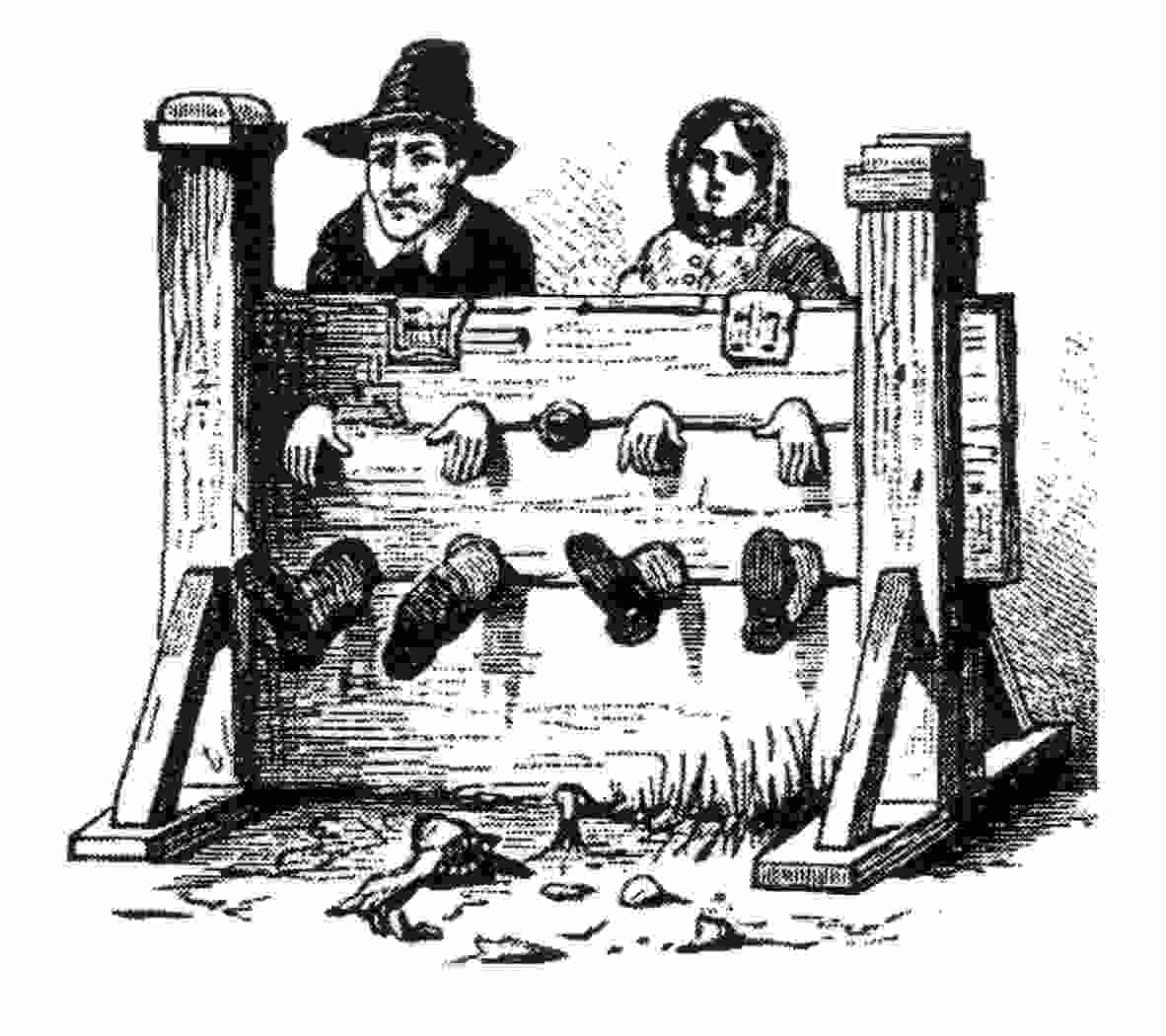
Maybe the ed deformers' next idea for "improving" the "effectiveness" of public school teachers will be to bring back the stocks. I expect U.S. Secretary of Education Arne Duncan would also cheer that on.
From Wikipedia: "Stocks are devices used in the medieval times for torture, public humiliation, and corporal punishment. The stocks partially immobilized its victims and they were often exposed in a public place such as the site of a market to the scorn of those who passed by. Since the purpose was to punish offenders against the standards of conduct of the time anybody could assault, revile or aim filth at the victim."
Blaming teachers is the current hottest fad in “education reform,” and the sub-fad is pronouncing that getting rid of “bad teachers” would magically solve all our problems.
Of course there are some truly problematic teachers who shouldn’t be teaching at all, so let’s note that right off the bat. But what I’m addressing here is the frequently repeated claim that the private sector just efficiently gets rid of the bad and rewards the good and doesn’t have these problems. A parent posted the comment below on one of our local education listserves in response to one of those claims. I’m reposting it anonymously with her permission.
“I have to chime in about the supposed efficiencies of the private sector. My husband works for a large corporation that, like so many, first underwent "extreme hiring" during the boom and then underwent massive layoffs.
“If the private sector was so good at weeding those who perform poorly from those who do well, you'd think only the best and the brightest would be left, but that isn't true. Certainly he works with a lot of great people, but there is still dead wood, including a couple in management. Usually these are people who talk a good line (and so might be best used in sales, to be honest), but never turn in their piece of the project on time.”
Here’s my own view. My background in a private-sector industry is in unionized daily newspapers. Our pay scale was based on seniority, from <1>6 years, and then negotiated raises in the contract. "Overscale" pay could be and was awarded on an individually negotiated basis -- the equivalent of merit pay, of course.
The universal belief among my colleagues was that overscale was awarded when an employee was in a specific position to leverage management – for example, I made some due to taking on an unappealing position that nobody wanted, in an emergency – or to employees who were particularly aggressive and skilled at negotiating.
There was not a shred of belief in our newsroom that overscale was awarded based on actual pure merit.
I still sometimes see the byline of a former co-worker who was barely functional doing the actual job (reporting, writing, editing) but who was always charming, persuasive and winning, and gave great meeting. That colleague moved up from my former workplace, the San Jose Mercury News, to one of the names you would immediately mention if you were asked to name the nation’s top three or four newspapers.
I’m not sure where the people who believe that the private sector is so great and successful at rewarding the good and weeding out the bad have been working, but I’m not completely convinced it’s on Planet Earth.
[The above is a guest post by Caroline Grannan]
------------
The P.P. adds:
Not only is the private sector incapable of assembling a body of perfect workers, they sometimes eliminate the best ones they have if the powers in authority don’t “like” what someone is doing (think vengeful principals).
BILL MOYERS: I watched the testimony where you were present the other day in the Lehman hearings. And there was a very moving moment with a former vice-president of Lehman Brothers who had gone and tried to blow the whistle, who tried to get people to pay attention to what was going on. Take a look.
MATTHEW LEE: I hand-delivered my letter to the four addressees and I'll give a quick timeline of what happened, May 16th was a Friday, on the Monday I sat down with the chief risk officer and discussed the letter, on the Wednesday I sat down with the general counsel and the head of internal audit, discussed the letter. On the Thursday I was on a conference call to Brazil. Somebody came into my office, pulled me out, and fired me on the spot with out any notification. I stayed, sorry.
BILL MOYERS: Matthew Lee, vice-president of Lehman Brothers, fired because he tried to blow the whistle. What does that say to you?
WILLIAM K. BLACK: Well, it tells me that they were covering up the frauds, that they knew about the frauds and that they were desperate to prevent other people from learning.
BILL MOYERS: Matthew Lee told the accounting firm Ernst & Young what was going on. Isn't the accounting firm supposed to report this, once they learn from somebody like him that there's fraud going on?
WILLIAM K. BLACK: Yes, they're supposed to be the most important gatekeeper. They're supposed to be independent. They're supposed to be ultra-professional. But they have an enormous problem, and it's compensation. And that is, the way you rise to power within one of these big four accounting firms is by being a rainmaker, bringing in the big clients.
And so, every single one of these major frauds we call control frauds in the financial sphere has been-- their weapon of choice has been accounting. And every single one, for many years, was able to get what we call clean opinions from one of the most prestigious audit firms in the world, while they were massively fraudulent and deeply insolvent.
BILL MOYERS: I read an essay last night where you describe what you call a criminogenic environment. What is a criminogenic environment?
WILLIAM K. BLACK: A criminogenic environment is a steal from pathology, a pathogenic environment, an environment that spreads disease. In this case, it's an environment that spreads fraud. And there are two key elements. One we talked about. If you don't regulate, you create a criminogenic environment because you can get away with the frauds. The second is compensation. And that has two elements. One is the executive compensation that people have talked about that creates the perverse incentives. But the second is for these professionals. And for the lower level employees, to give the bonuses. And it creates what we call a Gresham's dynamic. And that just means cheaters prosper. And when cheaters prosper, markets become perverse and they drive honesty out of the market.
Black explains more about “Gresham’s dynamic” in his piece “The Audacity of Dopes” (Huffinton Post, 2/10/2009)
Executive compensation and the compensation systems used for appraisers, accountants, and rating agencies were designed, and served, to create the perverse incentives and ethical rot that caused the ongoing financial crises by producing a "Gresham's dynamic" in which fraudulent and abusive lending and accounting practices drove good practices out of the marketplace.
There is no doubt that this same mentality has settled into the business of education reform. The data-driven obsession has created an environment that offers perverse incentives and causes ethical rot. Just google “test score cheating scandals” to see the fraud; it's just the tip of the iceberg.
Elevating data as supreme then using it to dismantle public school systems is only one piece of evidence that the mentality operating on Wall Street is the same one driving today’s ed reform. Find out more about what's behind it here, and wish us all luck.
Remember Arne Duncan’s Race to the Top? That’s the program he picked Joanne Weiss to develop and run which requires states to revise their education laws according to the Broad/Gates template, after which, if the states have gone far enough, they can become eligible to enter the contest for possibly getting some money from Duncan’s pot.
Weiss, by the way, is a businesswoman and the former COO of the NewSchools Venture Fund, an investment vehicle which funnels philanthropic dollars into charter school start-ups. Lots of Eli Broad connections there.
With states being so desperate to get any amount of money, many rushed to change their laws and then applied to RTTT. But, to their disappointment, most states were rejected. Only two states “won” in the first round, Delaware and Tennessee.
In my letter to the editor published in the Oakland Tribune last fall (11/20/2009), I tried to communicate that the massive fundamental bureaucratic alterations this “race” was requiring would mean that a lot of the money would be going to administrative positions rather than to kids and classrooms. In California, State Senator Gloria Romero from LA, who is backed by Eli Broad and pals and is a candidate for State Superintendent, was behind the push for the federally-accommodating laws.
Now we learn that Tennessee, which received $500 million, will be spending at least $46 million for data programs, while bus drivers and custodians are either having their wages cut, or are being laid off. This will make some ed data software business out there happy.
Not only that, but now that many state education laws have been changed, the amount of potential federal prize money has been reduced!
So, after spending of millions of dollars on writing new laws and completing elaborate RTTT applications, which were scored by anonymous judges (!), several states felt bewildered and betrayed, and are now rethinking their interest.
PS: Hope y’all are aware of what’s going on in other places.
In Florida, the profession of teaching is about to be destroyed. Russo posted a sort-of entertaining cartoon about it. Funny, ha, ha.
And in Detroit, former Oakland City Manager Bob Bobb, who went to DC and eventually graduated from the Broad Superintendents Academy, is aggressively closing schools and charterizing Detroit’s public school system. His approach resembles Randy Ward’s (Oakland's Broad Supe #1) on steroids. Bobb’s official salary is $280,000, but he gets an additional $145,000 in private foundation money; the only philanthropic donor publicly identified is the Broad Foundation. Talk about a conflict of interest!
People often dismiss those of us who are concerned about the way in which public education is being dismantled as nutty conspiracy theorists.
Conspire (American Heritage Dictionary): 1. To plan together secretly to commit an illegal or wrongful act or accomplish a legal purpose through illegal action. 2. To join or act together; combine: factors that conspired to delay the project. [Middle English conspiren, from Old French, from Latin cōnspīrāre : com-, com- + spīrāre, to breathe.]
Yes, I do think certain wrongful acts have secretly been generated in the offices, and at social gatherings, of a very small number of wealthy, unelected people who, because of their wealth, have exceptional access to politicians, and who stay TOTALLY-TOTALLY-TOTALLYinaccessible to public questioning or confrontation. They meddle in, and essentially are in control of, public education at very high levels, but keep themselves isolated from the public and seem to be accountable to no one. People like Duncan and Obama are permitting this to happen. I do know that the reforms didn't come from parents, they didn't come from teachers, they didn't come from academia, and they always have strong elements of a move towards privatization.
It’s happening all over, and rapidly now. In March 2009, just after the presidential election, Tom Vander Ark, one of the ed deformers’ favorite PR men, wrote a piece for The Huffington Post entitled, “Eli Finally Won.” It pretty much sums things up. The bold is mine.
Eli Broad paved the way for radical moderates. He was a New Democrat before Clinton. He was a Democrat for Education Reform before there was a DFER.
He figured out long ago that there was a talent gap in education and began investing in human capital. In addition to a great superintendent program, Eli formed a residency to bring MBAs into district cabinets and a training program for school board members. Eli also invested in Teach for America, New Leaders for New Schools, New Teacher Project, and Education Pioneers.
Eli saw the potential for quality at scale in charter schools. He invested in New School Venture Fund. Eli brought KIPP to LA. In post-Katrina New Orleans, Eli saw the potential to rebuild a different and better system and he invested in talent and charter networks.
When I brought the Stand Up advocacy campaign to Eli in 2006, he signed up but was frustrated that it wasn't edgier. He partnered with the Gates Foundation on Strong American Schools and was still frustrated that it didn't push harder in the resulting 'Ed in 08' campaign which tried too hard to build a big tent. And then education was pushed off the agenda by Iraq and the recession.
But yesterday, Eli won. Obama's speech sounded like Eli wrote it. It was about choice and charter schools, human capital and performance pay. It was right on message from pre-school to college. We've never had a Republican president that so clearly articulated a Republican strategy. Only it's the new New Democrat strategy. It's Eli's strategy. He finally won.
You will notice that Eli Broad (rhymes with toad) stays perpetually hidden from public view. He crawls out from under his rock just enough to meet with his puppets and henchmen, and to testify on behalf of his 20-count felony-charged friends.
Just so you can imagine the locus of the scheme, the Broad Foundation’s offices are located near UCLA in the Westwood district, at 10900 Wilshire Boulevard Twelfth Floor Los Angeles, California 90024 (at the corner of Wilshire and Westwood).
“After spending more than thirty years working in urban education, I have finally found a lucid description of many of the things I experienced as a classroom teacher and administrator. Hopefully the education community will use Dr. Payne's observations and insights in their efforts to improve urban education.” (Amazon reviewer, T. Tenny on "So Much Reform, So Little Change: The Persistence of Failure in Urban Schools"by Charles Payne)
In an effort to promote this book, I offer you a few excerpts from the first chapter. The bolds are mine.
Chapter 1: Dimensions of Demoralization
If we take organizational morale to be “the enthusiasm and persistence with which a member of a group engages in the prescribed activities of that group” (Manning 1991), the fact that an institution needs to squelch and marginalize its most energetic, most enthusiastic, or best-prepared members tells us these are demoralized institutions…
All this stands behind clocks that don’t get fixedand broken windows that don’t get repaired. Failed institutions make the simplest things difficult. The problems manifest themselves in so many ways that they may obscure the fact that many of the discrete problems are either generated by or reinforced by the sheer lack of connectedness among people. Giving up on the institutional mission goes hand in glove with giving up on one’s colleagues. The denizens of demoralized social spaces do what they have to but without little heart or hope. (p. 23)
- - - - - - - - - - - - - - -
Whenever we talk about the social climate in inner-city schools, we need to make a special effort to remember that what we are seeing has structural roots. It is all too easy to see grown people acting like fools and assume that’s all they are. Take a decently functioning suburban school, take away 40 percent of its funding, most of its better teachers, and the top-performing 50 percent of its students, and see how much fun faculty meetings would be after that. If we give people an enormously challenging task and only a fraction of the resources they need to accomplish it, sooner or later they start to turn on one another, making the job more difficult still. If we are not mindful of the inadequacy of the resource base, it always seems as if the problem is just those nutty people teaching in urban schools, as opposed to the conditions under which we expect them to teach. (p. 24)
- - - - - - - - - - - - - - -
About the manifestation of weak social webbing and the Principle of Negative Interpretation:
Whatever other people do is interpreted in the most negative way possible. If parents don’t show up at school, what does it mean? That they don’t care. If a colleague fails to make hall duty, what does it mean? That she’s blowing off her responsibility. If a principal fails to observe classes? She doesn’t care about the kids. But if parents do show up? They’re just coming to stick their noses in our business. If the colleague shows up for hall duty? Sucking up to the principal. If the principal does start doing observations? She’s just trying to impress the people downtown—and why is she just starting now? If a teacher is really nice to students, they may take that as proof she thinks they’re dumb and won’t hold them to any standards. If she’s mean? Racist bitch. Ambiguous evidence is consistently interpreted in the most negative way possible; no one gets the benefit of the doubt. (p. 25)
- - - - - - - - - - - - - - -
A negative climate is fertile ground for the development of factions—older teachers versus younger ones; primary-grade teachers versus upper grade; third-floor teachers against first-floor teachers; constructivist, inquiry-oriented teachers versus traditional ones; teachers in the annex against teachers in the main building; Spanish-speaking teachers against English-speaking ones; U.S.-born Spanish-speaking teachers against Spanish-speaking teachers born elsewhere. Race and ethnicity are powerfully implicated in these divisions—as well as in most aspects of school interpersonal dynamics—but rarely acknowledges the 800-pound gorilla that everyone pretends not to see. (p. 27)
- - - - - - - - - - - - - - -
It bears repeating that climates of pervasive distrust mean that schools cannot make use of financial and technical resources even when they become available. Inner-city schools are criminally under-resourced; still, in demoralized schools, making resources available hardly means they will ever be brought to bear. Expensive teaching materials sit on a shelf because teachers don’t believe they will make any difference, or they wind up in the room of a teacher who has political pull but no notion of how to use them. Those conservatives who say urban school systems waste substantial resources are exactly right, however little they understand the context. (p. 30)
- - - - - - - - - - - - - - -
The weak social webbing of bottom-tier schools makes it difficult for the schools to use resources from the outside, but is also degrades the human resources already there. In the toughest schools, change agents would be well advised to proceed as if operating in a place suffering from collective depression. (p. 31)
- - - - - - - - - - - - - - -
An excerpt from a study done by the Consortium on Chicago School Research:
Social trust is a highly significant factor. In fact, it may well be that social trust is the key factor associated with improving schools. Teachers in the top 30 schools generally sense a great deal of respect from other teachers, indicating that they respect other teachers who take the lead in school improvement efforts and feel comfortable expressing their worries and concerns with colleagues. In contrast, in the bottom 30 schools, teachers explicitly state that they do not trust each other. They believe that only half of the teachers in the school really care about each other and they perceive limited respect from their colleagues.
There were similar patterns in terms of parent-teacher trust: “In the bottom 30 schools… teachers perceive much less respect from parents and report that only about half of their colleagues really care about the local community and feel supported by parents.” (p. 34)
- - - - - - - - - - - - - - -
It goes without saying that the schools with the weakest social webbing are likely to be concentrated in the neighborhood with the weakest social capital… neighborhoods with strong social capital are four or five times as likely to have high-functioning schools as neighborhoods where the residents feel disconnected from one another. At the neighborhood level and at the school level, our most vulnerable students are vulnerable precisely because they are surrounded by adults who cannot cooperate with one another. (p. 38)
- - - - - - - - - - - - - - -
The theme of the next two chapters is that demoralized environments lead to people being invested in the failure of those around them. My failure gives me reason to hope for yours. The more plausibly parents can point the finger at teachers, the less they need to worry about how good a job they are doing as parents. The more teachers can point to the inadequacies of principals, the less reason for scrutinizing their own behavior. At the same time, principals have to answer to the people downtown, and as chapter 5 will argue, that has meant answering to people who are collectively incompetent and technically irresponsible. There has not been much connection between the things that animate them and the lives of children and parent and teachers. Yet if principals want to keep their jobs, they have to keep these people happy. This, then, is the terrainagainst which inner-city principals must lead, with the legitimacy of their position up for questioning from the very beginning, with the people around them predisposed to being critical and carping and the people above them capable of doing little more than posing new problems. Small wonder that the micropolitics of many failing schools becomes particularly contentious or that many principals can’t find a better way to negotiate their situation than by becoming petty autocrats. (p. 41)
- - - - - - - - - - - - - - -
I suspect that one of the reasons we have such persistent difficulty appreciating how damnably hard it is to change urban schools is the lack of respect we have for the people who work in them, which then predisposes us to simplistic answers. It is useful to be reminded that it is not, fundamentally, a problem that can be reduced to just the people in schools. The people in inner-city schools are reacting to sustained failure much as people in other failed institutions do. (p. 45)
- - - - - - - - - - - - - - -
The fundamentally ahistorical, nonsociological, and decontextualized thinking that dominated this discourse makes it hard to appreciate the overdetermined nature of failure in the inner city. If we did appreciate it, we wouldn’t have so many proposals that assume that if we just had more accountability, if we just had better teachers, if the teachers just cared more about children, if we just paid them more, if we could just operate schools under free-market principles, if we could just operate them more democratically, if we just put a computer on every desk, if we could just get schools to make decisions based on data, if we could just make lifelong learners of teachers, if we just put teachers in professional learning communities, if we just guaranteed every child a college education, everything wourd be all right. There is a mammoth disconnect between what we know about the complex, self-reinforcing character of failure in bottom-tier schools and the ultimately simplistic thinking behind many of the most popular reform proposals. What this seems to imply is not an argument for this or that program, but rather, for a style of work, a more intensive and robust way of intervening. (p. 45)
The PP says:
One of the things that bugs me the most is the cruel and insulting speech that accompanies the current reform movement. It is usually spoken by people who have never personally experienced these schools, and, therefore, it comes from a place that has no understanding of the dynamics.This harmful speech is the exact opposite of what those schools need, because it only produces more demoralization. That is just one reason why I don't trust the reformers or their motives.
The extreme amount of hatred and venom being hurled at public school teachers these days has got to be some sort of misdirected expression of the deluded people who still think that all things are possible for all people in this country. Or, is it the result of manipulation by those who are fully aware of what is going on and decided to toss in a red herring?
This country’s social mobility has pretty much hit the wall and we are entering uncharted territory. The empire is in decline. The citizenry knows that things aren’t right, but still haven't completely computed it. They don’t know what else to do other than to join in the fun of blaming a whole class of workers.
Mind you, I am not a teacher and I don't belong to a union. I am a longtime urban public school parent observer who is monitoring events and sensing that something evil is afoot.
Did you see Newsweek last week? What a stunning and uninformed attack on teachers and teachers' unions. The cover of the magazine told the story: The Key to Saving American Education, by Evan Thomas and Pat Wingert. It was printed on a classroom blackboard. In the background, on the same blackboard, was the handwritten phrase, repeated again and again, "We must fire bad teachers."
The story itself is a parody of a right-wing rant. It seems that the nation's classrooms are overrun with "bad teachers," pedophiles, "weak" teachers, ineffective teachers, dumb teachers, and others who remain in the classroom only because they have "lifetime tenure." Evil teachers' unions protect these people who are harming our nation's children. Researchers now know, the writers say, that if we could fire all these malingerers, the notorious achievement gap between the races would soon close and America would once again lead the world in education.
I submit to you that teachers have been targeted because their work symbolizes our nation’s uncertain future. It is easy to attack the nurturers and caregivers of our children because they are fairly ineffective with defending themselves and with retaliating against the attacks. Stressed public school teachers are too busy working on the daily tasks of trying to make 25-35 kids focus on class work and behave right, and at the end of the school day, their energy is drained. Add to that the fact that, these days, the teachers are increasingly demoralized. I believe this demoralization is one of the primary goals because it produces emotional breakdown and powerlessness.
It would be much harder for people to go after the higher status entities that function with an aggressive, masculine nature, like the business, legal, or warrior classes. What else explains why the nation’s response to what Goldman Sachs did (and is still doing) to us has been so muted?
So why go after the teachers? Because they’re easy targets and bullying is an adrenaline rush. It's also easier to bully and blame than to deal with the deeper, societal issues that eat away at this country.
The nasty scapegoating mentality is best revealed by the “no excuses” rhetoric. But the fact is that we will never be a society where everyone gets a college degree, where people at higher positions on the social ladder willingly sacrifice their spot to someone else, and where the poor and the less fortunate don’t exist.
As for the scene in urban areas, Michelle Alexander (author of “The New Jim Crow”) is telling the difficult-to-hear-truth: America now has a permanent under-caste. She writes:
Racial caste is alive and well in America.
Most people don’t like it when I say this. It makes them angry. In the “era of colorblindness” there’s a nearly fanatical desire to cling to the myth that we as a nation have “moved beyond” race. Here are a few facts that run counter to that triumphant racial narrative:
*There are more African Americans under correctional control today -- in prison or jail, on probation or parole -- than were enslaved in 1850, a decade before the Civil War began.
*As of 2004, more African American men were disenfranchised (due to felon disenfranchisement laws) than in 1870, the year the Fifteenth Amendment was ratified, prohibiting laws that explicitly deny the right to vote on the basis of race.
* A black child born today is less likely to be raised by both parents than a black child born during slavery. The recent disintegration of the African American family is due in large part to the mass imprisonment of black fathers.
*If you take into account prisoners, a large majority of African American men in some urban areas have been labeled felons for life. (In the Chicago area, the figure is nearly 80%.) These men are part of a growing undercaste -- not class, caste -- permanently relegated, by law, to a second-class status. They can be denied the right to vote, automatically excluded from juries, and legally discriminated against in employment, housing, access to education, and public benefits, much as their grandparents and great-grandparents were during the Jim Crow era.
Think any of this might impact the academic achievement of the children born into this caste? Of course, you will never hear anything significant about this theme acknowledged or uttered by the people now setting education policy and pushing for "reform." That such a stark admission is missing is either by intentional neglect, or because their heads are buried in the sand.
Either way, this country's approach is very dangerous stuff. It's a bit difficult to bring this up out loud, but is anyone else getting that slight sense that fascism and/or thoughts of genocide are lurking in the wings?
...Blacks and Hispanics, and especially those who are young and those who are poor, are disproportionately singled-out for this peculiar form of police harassment. Mayor Michael Bloomberg, Commissioner Kelly and other top leaders in this town would never tolerate this kind of systematic abuse of middle-class or wealthy, white New Yorkers.
The overwhelming majority of the stops yield no law-enforcement benefit whatsoever. An analysis of the stops in the first three quarters of 2009 showed that contraband, which usually means drugs, was found on just 1.6 percent of the blacks who were stopped, 1.5 percent of the Hispanics, and 2.2 percent of the whites (who are stopped far less often than the other groups).
The word “backlash” is actually being used about a so-called school reform maneuver so shortsighted and coldblooded that almost no one is speaking up in support of it – almost no one but President Obama.
Last month, all 93 members of the faculty, administration and support staff of Central Falls High school in Central Falls, R.I., were told that they’re fired as of the end of this school year.
Then, on Monday, President Obama spoke up, according to the New York Times. “Mr. Obama said he supported the school board’s decision to dismiss the faculty and staff members. ‘Our kids get only one chance at an education and we need to get it right,’ he said.”
(Obama’s lightweight, resume-faking Secretary of Education praised the move too, but he’s not really worth devoting blogosphere bandwidth to.)
Despite the current climate in which blaming, bashing and demonizing teachers has become a comfortable and popular theme in all kinds of commentary, Obama’s remark actually seems to have provoked dismay and outrage. In the most current news article showing online as I write this, the Providence Journal uses the term “wildfire.”
“The wildfire of national debate over the mass firings at Central Falls High School spread further Tuesday, when the executive council of the AFL-CIO unanimously condemned the removal of all 93 teachers, support staff and administrators at the city’s only high school.
The executive council said its members were “appalled” that President Obama and U.S. Education Secretary Arne Duncan had endorsed the terminations in recent comments, and said the firings will not help the 800 students at the high school, which is one of the poorest and lowest-performing schools in Rhode Island.”
Well, I have a proposal. Those 93 teachers, support staff and administrators should get together, pull the necessary strings (which are in their reach right now while the story is hot), and request a meeting with the president – all 93 of them. If Obama could have a beer with Henry Louis Gates and that cop whose name I’ve now forgotten, surely he’s willing to spend a little time hearing the viewpoint of 93 people whom he has essentially attacked sight unseen. While it would be hospitable for him to invite them to the White House, it would be a lot classier for him to have a soothing spot of tea catered in at Central Falls High School. (And he desperately needs to show a little class right now; his supply is perilously low.) I’m sure the cafeteria has enough room to seat the Central Falls 93, Obama and his entourage.
Two years ago, it would have been impossible for me to imagine saying this, but I also propose that President Obama emulate something San Francisco Mayor Gavin Newsom has been doing. I’m not normally Newsom’s biggest fan, with the exception of back in February 2004 when his then-revolutionary gay marriages were spreading joy through San Francisco. But lately, my city's mayor has been doing something admirable after being challenged by Patricia Gray, the longtime rock-star principal of San Francisco’s Balboa High School. Newsom has been spending Saturdays calling the homes of students who are chronically truant from their San Francisco public schools. The San Francisco Chronicle’s Matier and Ross political insider column wrote about this in a Jan. 31 column (not available online.)
“It has been a real eye-opener,” Newsom told the Chronicle. “In just about every case,” Matier and Ross wrote, “the family is in crisis.” In other words, truancy isn’t all the fault of inept teachers and uncaring schools after all, Newsom is learning.
At last week’s overflowing Town Hall meeting called by San Francisco parents to address the current budget crisis, Newsom brought up his calls (and visits) to the homes of truants, and reiterated that point quite emphatically. The truants are almost always living in households battered by the worst life can dump on them, and it’s unrealistic to expect educators to magically cure it all, and to blame them for not working miracles.
Well, if Newsom – who I never would have thought could hold a candle to Obama in depth and thoughtfulness – can accept Patricia Gray’s challenge and gain such new understanding, where’s the president?
I hope to read about that meeting in the Central Falls High School cafeteria soon.
For more on the Central Falls firings, here’s a snippet of commentary by veteran Washington Post education writer Valerie Strauss (now apparently writing as a freelancer, speaking of employment turmoil):
“…93 names were called for firing -- 74 classroom teachers, plus reading specialists, guidance counselors, physical education teachers, the school psychologist, the principal and three assistant principals, according to the Providence Journal. Not one was good enough to stay.
Some of the teachers at the city's only high school cried, but the committee held firm.
It's no wonder that Education Secretary Arne Duncan applauded the move, saying the committee members were "showing courage and doing the right thing for kids."
Courage, indeed.
Now, all they have to do is find 93 excellent professionals to take their places. Recruiting the best educators should be easy, especially when you can offer them life in a very poor town and a job with no security."
- - - - - - - - - - -
The Perimeter Primate adds:
Sign this petition in support of the teachers and staff of Central Falls High School in Rhode Island.
Notice that when politicians and business leaders talk about education woes, you’ll rarely, if ever, hear them utter a word about the well-known, perpetual, and unbreakable connection between average academic achievement and social class – a connection which exists in every society on this earth, and always has, and always will. It is only when we start to convert our economy and government to a form which reduces our vast social class differences will we see a reduction in the achievement gap.
In the meantime, people who have attained higher status are simply not going to voluntarily switch their spot on the social ladder (or sacrifice their offspring's spot) with someone who is on a lower rung of that ladder. We happen to be primates who can't help but function according to a social hierarchy.
You will hear politicians and business leaders calling our public schools “failures” and “dropout factories” – only referring, of course, to the urban schools which happen to contain a lot of poor kids. It has become commonplace for our leaders to describe the teachers who work in those schools as “lazy” and “selfish." Declarations are made that the teachers are more interested in meeting their adult needs rather than those of the children. As I watched a public school teacher acquaintance grade his students' papers into the evening hours last night as he waited for his daughter to complete her after school lessons, I did not think of the adjectives "lazy" and "selfish."
If you pay attention, you’ll find that the people who spout this type of rhetoric haven’t ever personally experienced the types of schools they are denigrating. So, I ask, why do we listen to people who could not possibly understand what the urban school environment is like, nor have any idea about what the teachers who work in those schools do, or do not do – hour after hour, day after day, and year after year? It's as if the nasty feelings these outsiders express are some sort of psychological transference of the guardedness and overall contempt they have for the poor, co-mingled with a sense of patronization and superiority over those who are actually willing to have daily contact with poor kids.
Is not it obvious that at the heart of this broad, negative labeling of a whole group of people – such as the huge attack that President Obama lobbed at the Central Falls High School teachers – is simply propaganda using stereotyping and scapegoating to build up more negative public sentiment and mistrust?
And what you won’t hear is our top leaders and managers addressing any awareness of the fact that the U.S. has the highest childhood poverty rate of the industrialized countries. In the Central Falls school district, the poverty rate is 90 percent.
Consider the degree to which public opinion has been manipulated over time so that our public schools are now largely viewed as the singular entity to be held accountable for producing the cure for our nation’s poverty and extreme social class differences (by closing the achievement gap), not to mention to correct the side effects caused by the disintegration of our once-much-stronger social institutions, such as the family and neighborhood communities.
Diane Ravitch’s new book, “The Death and Life of the Great American School System: How Testing and Choice Are Undermining Education,”contains a chapter entitled “The “Billionaire Boys’ Club” which reveals the role of the CEO billionaire trio of Gates, Broad, and the Walton family who are funding the movement of school reform based on ruthless free market principals such as eliminating any labor force which is not perfectly compliant with what top management unilaterally dictates.
So, it is no accident that the incident in Rhode Island was generated by a 2008 Broad Superintendents Academy graduate, State Education Commissioner Deborah A. Gist. The April 2009 press release announcing her appointment as the new R.I. Commissioner of Elementary and Secondary Education stated, “We are thrilled that Rhode Island is the first state to attract a Broad Fellow as not only the superintendent of its largest schools system, with Tom Brady in Providence, but also a Broad Fellow as a State Commissioner who can partner in addressing the challenges of transforming the state's educational systems to a position of international leadership."
Yes, the first time a state has placed a Broad Superintendents Academy Fellow in such a position happens to be the first education department to take the lead to fire every person on the staff of an entire school. It is unprecedented, and reminiscent of when Reagan fired all the air traffic controllers.
What Commissioner Gist just engineered in Rhode Island, with the blessing of President Obama, is the type of measure expected and required of the CEO business model "educators" who follow billionaire public-school-manipulator Eli Broad’s vision of urban public school “transformation."
I guess we now know the type of change we were expected to believe in.
More background reading:
Read why the elite crowd just doesn’t sufficiently understand the dynamics in urban public schools. It turns out they have a social disability.