I am positive that the profession of public school teaching -- and any remaining respect for that fine work -- is being destroyed right before my eyes. I simply do not understand the teachers’ passivity, nor that of everyone else.
What’s happening to public school teachers is breaking my heart, and I am so very, very grateful that my grandmother, Luella Robinson, did not live to see these times.
Mrs. Robinson graduated from Snow College in her hometown of Ephraim, Utah, and commenced to teach public school children for the rest of her life. She was an elementary school teacher for most of that time, finishing her years by teaching special ed.
This was a woman who absolutely loved children, and they loved her back. Dresser drawers in her home were filled with gifts from former students and their parents.
Since my sister and I ended up with a relatively unstable home life, we found refuge in the time we spent with our Grandma Robinson. Until we moved out-of-state, we would often spend Friday nights at her house. On the Saturday mornings, she would take us to the nearby train tracks and hold our hands as we walked up and down, balancing on the rails. Sometimes a slow train would come along and we would all wave to the operators and wait for the caboose.
Back at her little house in Sugarhouse (in Salt Lake City, Utah), she would encourage us make mud pies on her back steps and huge flour-water dough messes in her kitchen. We'd make blanket/furniture forts, swing on her willow tree’s branches, pick hollyhocks and use toothpicks to turn them into little dolls, draw and paint, read books, decorate cookies, and drink Dr. Pepper.
After she retired and we were older, if we all went shopping and there was a little child standing in line, Mrs. Robinson would approach that child and parent, say some kind words, and give the child a nickel. In those days, a nickel would buy something small that was tasty.
Luella Robinson was strongly against corporal punishment and shared her vision with other people in the world. To her, there was never (ever!) any reason to hit a child. “If a child is misbehaving," she explained, "all you need to do is get down to their eye level, place your hands on their shoulders, and look directly into their eyes as you are talking.”
I am certain that my grandmother put this same kind of love into daily practice in her classrooms during each and everyone of the years she worked. Her intelligence, grace, and skill are certain to have made a positive difference for hundreds and hundreds of children. Her life of teaching was not centered around test scores.
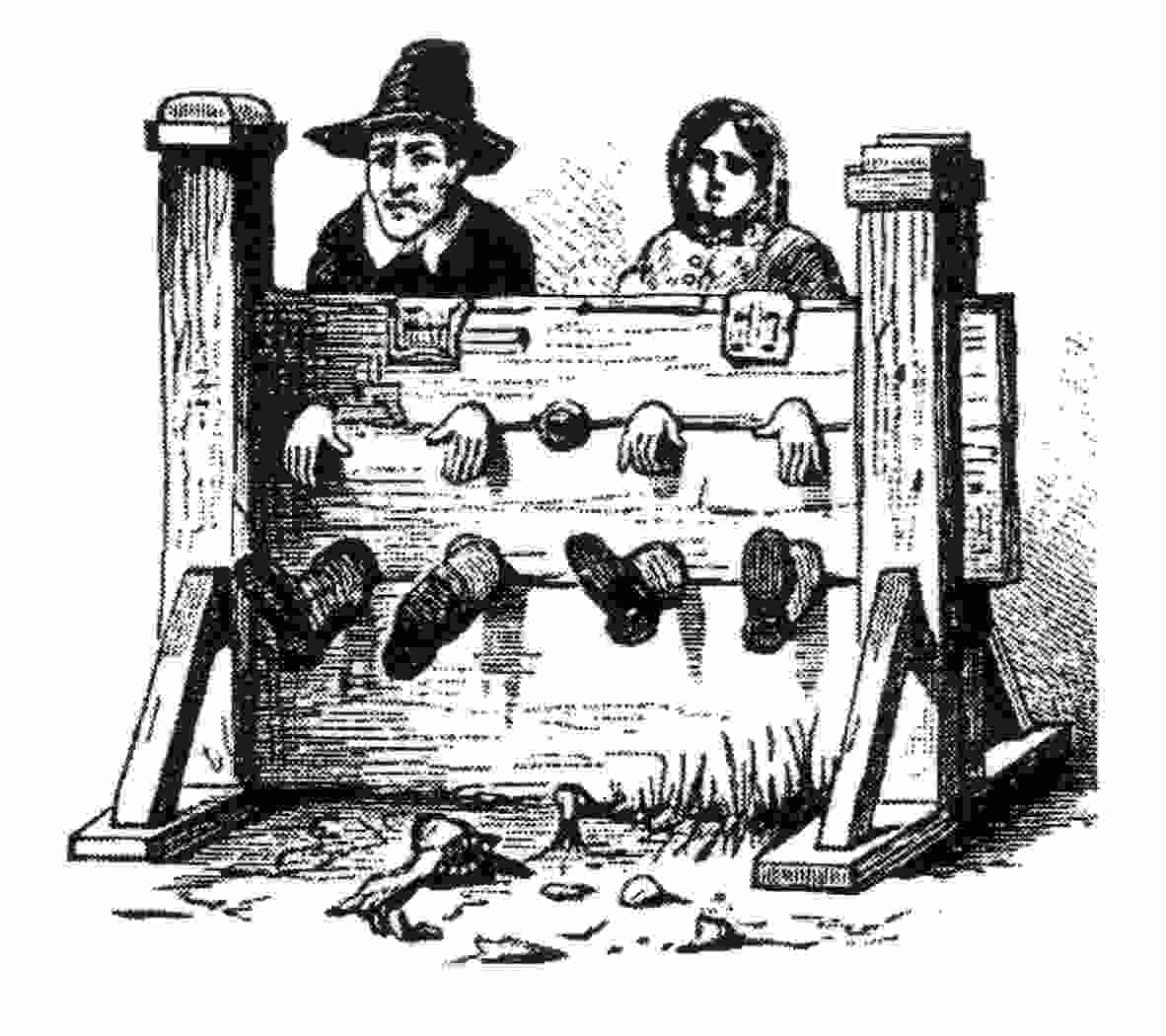
Maybe the ed deformers' next idea for "improving" the "effectiveness" of public school teachers will be to bring back the stocks. I expect U.S. Secretary of Education Arne Duncan would also cheer that on.
From Wikipedia: "Stocks are devices used in the medieval times for torture, public humiliation, and corporal punishment. The stocks partially immobilized its victims and they were often exposed in a public place such as the site of a market to the scorn of those who passed by. Since the purpose was to punish offenders against the standards of conduct of the time anybody could assault, revile or aim filth at the victim."
Very few, if any, urban public school systems have been spared from the pompous neo-liberal mentality of today’s education reform cabal.
Beware: Do NOT confuse the term “neo-liberalism” with “social liberalism.” There is NO connection.
Neo-liberalismis an economic theory that outlines a set of policies which support and promote the economic system of capitalism. According to CorpWatch, the main points of neo-liberalism include:
THE RULE OF THE MARKET. Liberating "free" enterprise or private enterprise from any bonds imposed by the government [Reduce wages by de-unionizing workers and eliminating workers' rights].
CUTTING PUBLIC EXPENDITURE FOR SOCIAL SERVICES like education and health care [In the name of reducing government's role and supporting government subsidies and tax benefits for business].
DEREGULATION. Reduce government regulation of everything that could diminish profits.
PRIVATIZATION. Sell state-owned enterprises, goods and services to private investors. This includes banks, key industries, railroads, toll highways, electricity, schools, hospitals and even fresh water [Usually done in the name of greater efficiency].
ELIMINATING THE CONCEPT OF "THE PUBLIC GOOD" or "COMMUNITY" and replacing it with "individual responsibility."
If you've been following the arguments for today's school reform movement, all these principals will sound familiar.
Americans usually associate “reform” with a movement that will make things better, for example, reforming child labor laws. However, this is a case where U.S. citizens need to be much less naive!
The ultimate outcome of today’s public education “reform” is the elimination of our children's schools as a public institution, followed by a rebuilding where all schools will be operated privately. This time, reform isn't going to mean any type of improvement which the trusting, average person is likely to have in their mind.
In the 19 months since I started this blog, I’ve connected with parents, teachers, and community members in Boston, New York City, Albany, Baltimore, Washington DC, Los Angeles, Sacramento, and Portland, Oregon. In each of those cities, people are experiencing the same neo-liberal siege of their local public school system. In some cases, the condition is at a very advanced stage.
Recently I had an exchange with the authors of Seattle Education 2010, a blog that focuses on charter schools as well as the presence of the Broad Foundation within Seattle public schools. They display the following quote from Albert Einstein at the bottom of their website:
‘The intuitive mind is a sacred gift, the rational mind is a faithful servant. We have created a society that honors the servant and has forgotten the gift.’
The rational mind beams brightly from the minds controlling public education reform today. Think about places like Harvard Business School and about all those now-interested-in-education MBAs. Think about Milton Friedman who designed the blueprint for the total corporate privatization of Earth. He was originally a mathematician and statistician who became an economist. And think about the billionaires who are suddenly devoted to "improving" public education. Eli Broad was a precocious Certified Public Accountant (the youngest ever in Michigan at the time) who became a corporate CEO. Bill Gates was a precocious computer scientist before he became a corporate CEO and the wealthiest, and thus the most powerful, person who has ever lived on this planet. There would be little balance in the minds of today’s education reform leaders; they are weighted down by their strategic business-minded rationality.
The danger of today’s education “reform” movement is that the arguments which defend it are so damn logical. That logic – potentiated by the billions spent on developing and pushing it – may be what is giving it so much strength. But might doesn't necessarily make right.
Unfortunately, their logic wins, especially when so many people don’t view propaganda with a critical eye, don't know that they need to be skeptical about grand claims, have absolute trust in “philanthropists,” and want the ugly problems which chronically exist in inner-cities to simply disappear.
They think to themselves, why not fixate on data? What's wrong with testing children a little bit more, and a little bit more? Why aren't teachers to blame when their students have trouble absorbing information in the classroom? Why not replace teachers with smart, analytically-minded, Ivy League-trained, 22-year-olds, even if they've only had six weeks of summer training? Why wouldn’t the KIPP model work for every single child, it makes them so obedient? What's wrong with calling students, their teachers and their schools "failures" when test scores don't measure up? What could possibly go wrong if our nation's public schools were replaced with those that are privately-run?
I really liked the Einstein quote, so I looked it up and found more great quotes about rationality and creativity.
On Rationality...
Being rational does not necessarily kill creativity, but it can very easily do so. This is because we are not rational, even though we think we are. Psychologists call it ‘bounded rationality' because although we have a deep need to appear rational, the world is simply too complex for us to fully understand.
Quotes:
‘Analysis kills spontaneity. The grain once ground into flour germinates no more.’ — Henri-Frédéric Amiel
‘No, no, you're not thinking; you're just being logical.’ — Niels Bohr
‘Sir, we must beware of needless innovation, especially when guided by logic.’ — Winston Churchill
‘Logic, like whiskey, loses its beneficial effect when taken in too large quantities.’ — Lord Dunsany
‘Many of the things you can count, don’t count. Many of the things you can’t count, really count.’ — Albert Einstein
‘Rules and models destroy genius and art.’ — William Hazlitt
‘Absence of evidence is not evidence of absence.’ — Martin Rees
‘Most of our so-called reasoning consists in finding arguments for going on believing as we already do.’ — James Harvey Robinson
I am writing to you from Oakland, California where I am longtime public school parent and public school activist. I have a deep interest in urban public school issues and read a great deal about them. Today I discovered your recent piece about Arne Duncan on an education blog called “This Week in Education.”
I want to let you know that I am grateful for your article and for posting the video of your interview with Mr. Duncan. I am particularly appreciative that you asked him why his focus is on test score data rather than on quality of life issues at schools, such as improving school climate, focusing on children's social and emotional issues, and developing ways to counter early expressions of urban violence. From my point of view, his response clearly demonstrated a simple lack of understanding.
I firmly believe that today’s education reformers are missing the mark because they are not addressing these things first. And I also believe that perhaps the reason for this is because they have never personally experienced the schools attended by children of the underclass, nor are they much willing to tap into the substantial body of knowledge of people who have. Too many of them have attended private schools and Ivy League colleges, and are only willing to send their children to the same. They're in charge of education for the masses, but are very much out of touch.
There is no doubt in my mind: the conditions relating to urban violence, and how they impact urban school climates, are the most pressing problems in our nation's inner city schools. They are the main barriers to better student performance and higher teacher retention. And as charter schools draw off the strongest families in our cities, the concentration of students from less-able parents – who are also the ones who present the greatest challenges – is becoming higher and higher at the traditional public schools.
Honestly, despite all the money and energy being thrown at urban school reform, we’re really not seeing much of an effect, because the path which has been taken is not correct. Frank public recognition of the biggest problem, and finding ways to address it, is nowhere to be found in typical ed-reform discussions.
The best source I've discovered for learning about the behavioral dynamics in the inner-city setting is Elijah Anderson, sociology professor at Yale, formerly of the University of Pennsylvania. He is the author of "Code of the Street: Decency, Violence, and the Moral Life of the Inner City" and is also the editor of an insightful new book, “Against the Wall: Poor, Black, Young, and Male.” Both President Obama and Arne Duncan – as well as policymakers and America's citizens – would learn a great deal from Anderson’s work.
And on a related note, last winter I read a blog comment by a professor at ChicoStateUniversity (Tony Waters on Bridging Differences) in which he referred to America’s “incarcerated class.” His phrase immediately rang true for me. The tragic and exponential rise in African American incarceration rates over the past decades is both causing, and resulting in, damage to many, many children. An increasingly tragic cycle is being produced.
On nearly every post here at the Education Report, people will eventually make comments that relate to the chronically intolerable/near-intolerable conditions caused by student misbehavior and its effects. Has anyone else noticed?
The in-hospitability of urban public school climates is NOT solely an OUSD issue, it’s present nationwide. The amount of student misbehavior that schools are expected to cope with these days is a big, widespread problem and has come about as a result of complicated and tragic societal forces, and decisions that seemed right at the moment but produced negative effects over time.
Does anyone know an entire school district with similar demographics that’s managing these challenges extremely well? Which specific schools in Oakland have this issue totally under control? How much do the student, teacher, and principal demographics influence their practices? How much can the techniques be replicated at other sites, and how can that be done?
Do some schools boast about their accomplishments, but then operate by rules or in conditions that can’t be transferred on a wider basis? Is the exclusive enrollment practiced by charters (like refusing to deal with the types of students in Special Day Classes or those who are more defiant) the only way to go? If so, where then should those many more difficult students be educated? Just how much of the difficult student behavior can be suppressed? What are the legal and civil rights issues that need to be considered?
I once heard a sociologist refer to America’s “incarcerated class.” Looking at the African American incarceration rates over the past decades, and thinking about the families those rates affect, maybe he’s onto something. So is it time yet to publicly admit that we probably have an established caste system in the US, and that the problems we’re talking about just might be connected to that?
The issue about school climate is THE “big nut” to crack. Finding strategies to deal with this difficult issue should have been placed at the very top of the urban educational reform list.
Unfortunately, educational reformers from the corporate world — who don’t understand or care about what is really going on in the trenches — are in control right now. They’ve been leading us down the path where everyone fixates on test scores, and scapegoats teachers, etc. because those are strategies that will eventually lead to the corporate world making a buck. Education entrepreneurship in a wide number of forms (tutoring, test materials, coaching, etc.) is now a huge, and growing, billion-dollar business, which developed from specific intent. In the 1980’s these people realized that the billions spent on public education was an untapped well of profit, so they made their political connections and have taken charge ever since. And so far we have let them.
If both OUSD and the City of Oakland would set its main focus on improving school climates, and if the school board and our superintendent addressed it at every turn, we could become a model for the rest of the nation — we’re a district of manageable size. But they will need firm pressure AND help in the form of fresh ideas and feedback. Constant put-downs and abandonment of the public schools don’t do anything to help our community as a whole.
How about more people writing letters to demand that the district turns its attention to school climate? How about asking the district to form a task force &/or department that compiles research, generates ideas, makes recommendations, monitors progress, and keeps up an exchange with the community? How about demanding that charter schools take their fair share of more challenging students? How about asking charters to use some of their innovation potential and extra funding to develop special programs for managing the more difficult students?
At any rate, these are the issues education reform needs to be dealing with, and I am certain you know this, too -- because of the questions you chose to ask Arne Duncan. How sad that his best response was “It’s crazy, it just doesn’t make any sense to me” and that his friend, John Rogers, said basically the same thing.
If these powerful people deeply understood the message in Anderson’s work, they would have been able to move beyond just describing things as “crazy.” They would know that the antisocial behavior exhibited by urban youth these days is, oddly, an adaptive and very human response to chronically horrific economic conditions. To understand urban violence, people need to read Anderson's explanation about the issue of "respect."
And if more people were aware of all these things, then maybe there would be hope for developing the plan for what needs to be done next.
Since his death last week, the ed blogs have been posting a lot about Frank McCourt and his musings on teaching. This is the piece I love the most. My thanks goes to Norm.
Stop Hijacking the Education with Hijinks
by Frank McCourt, January 14th, 2008
At what point in American history did politicians hijack public education? They think nothing of barging into classrooms across the country, shunting teachers aside and reading to children who wonder who they are in the first place, wonder who is this person boring us to death with his prose drone?
We all remember former Vice President Dan Quayle’s foray into spelling when, campaigning for a second term, he told a class of elementary school kids that potato was spelled potatoe. We remember how President George W. Bush read a story about a goat to children in Florida while the WorldTradeCenter burned. Imagine a politician daring to enter the professional space of doctors, lawyers, engineers, dentists, interior decorators. Imagine.
The kids are primed well in advance, told this person coming here tomorrow is very, very important, that they better behave themselves and show respect to this very important person who will be reading to them, this person taking time out from a hectic schedule to show his/her interest in education.
But teachers are fair game. Here come the press people, the camera operators, the advance men or women and, hold it right there outside the classroom for the big smile and the apt comment on the state of the schools, the solon himself, today’s captivating reader, the one who will show the teacher how it’s done.
Politician enters room, acknowledges existence of teacher, limp handshake, faint smile, head nod.
Some teachers are flattered, of course. They’ll be right up there on TV tonight, and tomorrow the kids will rush in all excited after seeing themselves and their teacher on the news.
Oh, wow!
There’s Joey. There’s Sandra. Yeah, and there’s a glimpse of teacher being recognized by politician. (Teacher has the sickly smile of one aware she is being used. But don’t be like that, Teacher Lady. After all, you were singled out, checked out, background looked into, political affiliation determined before this politician was invited to invade your domain. You are going to be on TV, recognized, however briefly, before politician sits warily on three-legged stool to bore your kids to death with a story he never heard of before today.)
So, there’s the teacher, there’s the politician, there are the children. And we know where the power is. We know that whatever happens in the classroom, however effective the teacher, however accomplished or failing the kids are, it is the politician who controls the purse strings of education. We know when you sit on the pot of gold you can dictate what should be taught, how it should be taught, and who should teach it.
We are talking, of course, about the United States of America. It may be different in other countries where there is respect for teachers, where, in the matter of teaching and learning, they are heeded.
What do we hear in public education about the pursuit of wisdom? Nothing. In the land of the free and the home of the brave, we have decided the way to improve the schools is through testing, testing, testing. Unless they test well we don’t like our children. We brag to neighbors and other parents that our Jonathan scored way up there on that No Child Left Behind test and if all the children scored way up there we’d get more money from Washington. And what right-minded citizen wouldn’t want that? Politicians from different states and localities are over the moon when “their” kids score high on this test and that test.
Then there are the teachers. Oh, well. Those silly people in public schools went into the profession thinking they’d teach, you know, excite the kids. Forget the test, the quiz, the exam.
Politicians bark: Hold it right there, Teacher Lady. We don’t care what you do in the classroom as long as it can be measured and tested. We want results. Understand? Results. I mean, you’re not Socrates blathering away under a tree. If we’re doling out funds, we wanna know what you people are up to in the classroom.
So … back to the drawing board, teacher. Think results. Teach to the test because if you don’t, your representatives downtown, upstate and in D.C. will sit on the pot of gold ’til you come to your senses. Principals and bureaucrats in general will question your professionalism and you know what that means, teacher. To have your professionalism questioned by people who long ago fled the classroom is a serious matter. You might lose your good job, teacher. What would happen to the children?
Oh, the children. Don’t worry about them. Teachers will soon be replaced with robots capable of administering tests. Everything will be multiple choice and robots certainly know how to handle that. Curiosity will be discouraged and there will be no departure from the test-driven curriculum.
And you, teacher? What will you do with yourself?
Try politics. That way you can re-enter the classroom and, get this: you’ll be respected. You can read to the kids a story about a woman who wanted to be a teacher but was replaced by a robot because politicians wanted results and the politicians got their way because they know more about education than the teacher in the classroom, don’t they?
Frank McCourt (1930 - 2009) won the Pulitzer Prize for "Angela’s Ashes." "Teacher Man: A Memoir" is an account of his experiences as a New York City teacher.
PS: Bill Gates, Eli Broad, Arne Duncan, Joel Klein, Michelle Rhee, and all the others put together, don't come close to approaching McCourt's brilliance of mind and understanding of humanity.
Arriving to the party somewhat late, I just learned about the Sandia Report and what happened to it. If you don’t know the story, you need to find out. It helps to explain why we're in such a miserable mess now.
This is just a very brief overview. If you know more, please add it in a comment.
American students are never first and frequently last academically compared to students in other industrialized nations.
American student achievement declined dramatically after Russia launched Sputnik, and hit bottom in the early 1980s.
SAT scores fell markedly between 1960 and 1980.
Student achievement levels in science were declining steadily.
Business and the military were spending millions on remedial education for new hires and recruits.
The Sandia Report (1990)
What was actually happening:
Between 1975 and 1988, average SAT scores went up or held steady for every student subgroup.
Between 1977 and 1988, math proficiency among seventeen-year-olds improved slightly for whites, notably for minorities.
Between 1971 and 1988, reading skills among all student subgroups held steady or improved.
Between 1977 and 1988, in science, the number of seventeen-year-olds at or above basic competency levels stayed the same or improved slightly.
Between 1970 and 1988, the number of twenty-two-year-old Americans with bachelor degrees increased every year; the United States led all developed nations in 1988.
* * * * * * * *
What we now call school reform isn't the product of a gradual consensus emerging among educators about how kids learn; it's a political movement that grew out of one seed planted in 1983. I became aware of this fact some years ago, when I started writing about education issues and found that every reform initiative I read about -- standards, testing, whatever -- referred me back to a seminal text entitled "A Nation at Risk."
Naturally, I assumed this bible of school reform was a scientific research study full of charts and data that proved something. Yet when I finally looked it up, I found a thirty-page political document issued by the National Commission on Excellence in Education, a group convened by Ronald Reagan's secretary of education, Terrell Bell.
* * * * * * * *
The heart of the document is an indictment that lambastes America for letting schools slip into precipitous decline but praises the nation's good heart, great potential, and mighty past. No paraphrase can do justice to its tone, so here's a verbatim sample: "Our Nation is at risk . . . . The educational foundations of our society are presently being eroded by a rising tide of mediocrity that threatens our very future as a Nation and a people . . . . If an unfriendly foreign power had attempted to impose on America the mediocre educational performance that exists today, we might well have viewed it as an act of war . . . . We have, in effect, been committing an act of unthinking, unilateral educational disarmament . . . ."
* * * * * * * *
When the report was released in April 1983, it claimed that American students were plummeting academically, that schools suffered from uneven standards, and that teachers were not prepared. The report noted that our economy and national security would crumble if something weren't done.
* * * * * * * *
Once launched, the report, which warned of "a rising level of mediocrity," took off like wildfire. During the next month, the Washington Post alone ran some two dozen stories about it, and the buzz kept spreading. Although Reagan counselor (and, later, attorney general) Edwin Meese III urged him to reject the report because it undermined the president's basic education agenda -- to get government out of education -- White House advisers Jim Baker and Michael Deaver argued that "A Nation at Risk" provided good campaign fodder.
* * * * * * * *
What made "A Nation at Risk" so useful to Reagan? For one thing, its language echoed the get-tough rhetoric of the growing conservative movement. For another, its diagnosis lent color to the charge that, under liberals, American education had dissolved into a mush of self-esteem classes.
In truth, "A Nation at Risk" could have been read as almost any sort of document. Basically, it just called for "More!" -- more science, more math, more art, more humanities, more social studies, more school days, more hours, more homework, more basics, more higher-order thinking, more lower-order thinking, more creativity, more everything.
The document had, however, been commissioned by the Reagan White House, so conservative Republicans controlled its interpretation and uses. What they zeroed in on was the notion of failing schools as a national-security crisis.
* * * * * * * *
By the end of the decade, Republicans had erased whatever advantage Democrats once enjoyed on education and other classic "women's issues." As Peter Schrag later noted in The Nation, Reagan-era conservatives, "with the help of business leaders like IBM chairman Lou Gerstner, managed to convert a whole range of liberally oriented children's issues . . . into a debate focused almost exclusively on education and tougher-standards school reform."
* * * * * * * *
From the start, however, some doubts must have risen about the crisis rhetoric, because in 1990, Admiral James Watkins, the secretary of energy (yes, energy), commissioned the Sandia Laboratories in New Mexico to document the decline with some actual data. [“Perspectives on Education in America”, aka The Sandia Report, ]
Systems scientists there produced a study consisting almost entirely of charts, tables, and graphs, plus brief analyses of what the numbers signified, which amounted to a major "Oops!" As their puzzled preface put it, "To our surprise, on nearly every measure, we found steady or slightly improving trends."
One section, for example, analyzed SAT scores between the late 1970s and 1990, a period when those scores slipped markedly. ("A Nation at Risk" spotlighted the decline of scores from 1963 to 1980 as dead-bang evidence of failing schools.) The Sandia report, however, broke the scores down by various subgroups, and something astonishing emerged. Nearly every subgroup -- ethnic minorities, rich kids, poor kids, middle class kids, top students, average students, low-ranked students -- held steady or improved during those years. Yet overall scores dropped. How could that be?
Simple -- statisticians call it Simpson's paradox: The average can change in one direction while all the subgroups change in the opposite direction if proportions among the subgroups are changing. Early in the period studied, only top students took the test. But during those twenty years, the pool of test takers expanded to include many lower-ranked students. Because the proportion of top students to all students was shrinking, the scores inevitably dropped. That decline signified not failure but rather progress toward what had been a national goal: extending educational opportunities to a broader range of the population.
By then, however, catastrophically failing schools had become a political necessity. George H.W. Bush campaigned to replace Reagan as president on a promise to confront the crisis. He had just called an education summit to tackle it, so there simply had to be a crisis.
The government never released the Sandia report. It went into peer review and there died a quiet death. Hardly anyone else knew it even existed until, in 1993, the Journal of Educational Research, read by only a small group of specialists, printed the report. [Read more about burying the Sandia Report here.]
* * * * * * * *
In 1989, Bush convened his education summit at the University of Virginia. Astonishingly, no teachers, professional educators, cognitive scientists, or learning experts were invited. The group that met to shape the future of American education consisted entirely of state governors. Education was too important, it seemed, to leave to educators.
School reform, as formulated by the summit, moved so forcefully onto the nation's political agenda that, in the 1992 presidential campaign, Bill Clinton had to promise to outtough Bush on education. As president, Clinton steered through Congress a bill called Goals 2000 that largely co-opted the policies that came out of the 1989 Bush summit.
After the 2000 election, George W. Bush dubbed himself America's "educator in chief," and until terrorism hijacked the national agenda, he was staking his presidency on a school-reform package known as the No Child Left Behind Act, a bill that -- as every teacher knows -- dominates the course of public education in America today.
* * * * * * * *
Testing provides another revealing example. Teachers have always used myriad formal and informal tools to see whether kids are learning what is being taught. No one is against assessment. But testing in the context of today's school reform is not about finding out what kids know; it's about who gets the test results.
Only on-site teachers can really make a broad ongoing assessment that gets at a range of achievements and takes the individual into account. By contrast, uniform standardized testing whose outcomes can be expressed as simple numbers allows someone far away to compare whole schools without ever seeing or speaking to an actual student. It facilitates the bureaucratization of education and enables politicians, not educators, to control schools more effectively.
* * * * * * * *
Don't be shocked if NCLB ends up channeling American education into that third current, even though it seems like part of the mainstream get-tough approach. Educational researcher Gerald Bracey, author of Reading Educational Research: How to Avoid Getting Statistically Snookered, writes in Stanford magazine that "NCLB aims to shrink the public sector, transfer large sums of public money to the private sector, weaken or destroy two Democratic power bases -- the teachers' unions -- and provide vouchers to let students attend private schools at public expense."
Why? Because NCLB is set up to label most American public schools as failures in the next six or seven years. Once a school flunks, this legislation sets parents free to send their children to a school deemed successful. But herds of students moving from failed schools to (fewer) successful ones are likely to sink the latter. And then what? Then, says NCLB, the state takes over.
And there's the rub. Can "the state" -- that is, bureaucrats -- run schools better than professional educators? What if they fail, too? What's plan C?
NCLB does not specify plan C. Apparently, that decision will be made when the time comes. But with some $500 billion per year -- the sum total of all our K-12 education spending in this country -- at stake, and with politicians' hands on all the levers, you can be pretty certain the decision will not be made by those whose field of expertise is learning. It will be made by those whose field of expertise is power.
A parent member of the Oakland Public School Parents listserv wrote to me yesterday. I’ve never met her, but she is concerned about the proliferation of charter schools, as am I. Like so many others, she is wrestling with the “district-can’t-get-rid-of-the-bad-teachers-because-of-the-union” issue.
She wrote:
The chinks in the armor for me are: my African-American friends who work in the flatland schools hate OEA -- they would love to fire teachers. Of course, where my kids are at school, [elementary school X], the teachers are good -- some are indeed great, others just acceptable. The ones who parents didn't think were good, somehow "moved on." Though I support unions and believe collective bargaining is necessary for labor (such as education) that is undervalued in our capitalist dominated society, OEA [the Oakland Education Association, our local teachers union] is a real problem…
So how does one get OEA to serve its teachers and students alike?
Here’s my response:
It's good to connect w/you.
I know the focus is a lot on the union protecting bad employees, but it is much more complicated than that. It is highly connected to parents being tuned in, or not, with how crappy their child's teacher is, and then complaining -- followed by a principal who is willing to go through the time-consuming process it takes to get a teacher kicked out.
I've been involved with two such scenarios personally during my time in OUSD and have watched how it works, and have seen what it takes. It's never easy, but a strong and committed principal will see the process through. I’ve also been involved with scenarios where the follow-through on either the administrative, or parent, end just wasn’t there.
What the flatland schools are missing is a force of parents who:
1. have recognized that what is going on in the classroom is crappy (being poorly educated themselves, too many of them have low expectations for teachers &/or they are too trusting &/or removed and don't follow what goes on for their kid so they don't complain to the principal, or don't speak English, etc.) -- &/or
2. they have a hunch that things aren't right but don't feel entitled, or know how, or aren't invited by the school to complain. Annette Lareau's book, "Unequal Childhoods: Class, Race, and Family Life," describes the general lack of entitlement felt by poor and working class people. The book is short and I highly recommend it to you.
[I would add that parents definitely have a reasonable fear of retaliation from teachers &/or principals if they complain. As confident as I am with navigating school issues, I've felt that myself and so have my daughters.]
On top of the parent dynamics, there is a layer of OUSD administration which equally contributes to the problem.
Administrative staff:
1. doesn't regularly, and proactively, seek out parent opinions (by making sure they complete surveys, checking in with them informally on a frequent basis, offering suggestion boxes, etc.) -- &/or
2. is dismissive of parents complaints (administrators have to sort out the legitimate complaints from the hard-to-tell-if-they-are-legitimate-or-not complaints of extremely hostile, sometimes violent, parents who have never learned conflict management skills, OR they are low-energy and apathetic administrators &/or they are overwhelmed by other administrative duties -- in either case they don't want to be bothered with these problems, etc.)
Parent and student perceptions if a teacher is good, or not, also vary drastically. I'll never forget an African American school secretary who I knew at Bret Harte tell me how much she hated an English teacher that both of our daughters had at Skyline. I thought this teacher (also African American), who was very rigorous and quite strict, was a really good teacher, and my daughter did, too, because a lot was expected in the class. That’s the type of environment my daughter liked. The secretary's daughter HATED the teacher and thought she was totally unfair, too hard, and mean.
By the way, my kids are biracial, but light, and are more culturally "white." As with the OJ Simpson trial, sometimes opinions split along race lines, so I am not shy about bringing race out into the open. In this case though, I think personalities, parenting styles, and social class were at play. Lareau talks about poor and working class parents being quite satisfied if their kid "likes" a teacher, meaning that it goes a long way for the family if they perceive a teacher to be "nice." Over the years, I've observed this phenomenon a number of times.
Yes, a process is required to eliminate a terrible teacher, and it has been in place for decades. The fact that terrible teachers are kept on for years and years is only more evidence of an overwhelmed school district which is not adequately interested in doing – or strong enough to do – what it takes to truly empower its parent body to be better parents for their children educationally-speaking. The district is not giving the kind of support to school sites so the administrators have time and the know-how to do what they need to do. Maybe the problem isn't the teachers' union, maybe it's because of a bunch of ineffective administrators!
The presence of poor teachers in schools is not exclusively the fault of the teachers’ union, as so many people seem to believe.
Also, it is a fact that some administrators can be extremely vengeful (or show extreme favoritism to their friends), and I would not trust them with the power to eliminate teachers at will. Some are just not mature and professional enough to be granted that authority.
Here's another story. Three weeks into this current school year, a couple of parents complained to the Skyline principal about one of these terrible teachers (he had been hired by the district over the summer). The principal called for a meeting with the teacher and the unhappy parents. Instead of coming to the meeting, the teacher never showed up, quit his teaching position, and totally disappeared.
Skyline was unable to get a replacement from HR until after the 4th marking period of the school year. This means that the teacher's abandoned classes have been taught by a string of substitutes for 2/3 of the school year. These were 10th grade English classes and they probably account for 140 kids or so.
The test that determines the academic progress at the high school level is the CAHSEE given to 10th graders. How do you think this set of kids will do? The principal did his part, so why – given what was at stake – didn't the district make the replacement of that teacher a top priority?
In other words, when the crappy teachers leave, there is not a pool of magical, excellent teachers waiting to replace them. The district would be better off if it could somehow build its replacement pool, and this is a good argument for becoming a regionally top-paying district. OUSD desperately needs something that can entice all those "good" teachers we want.